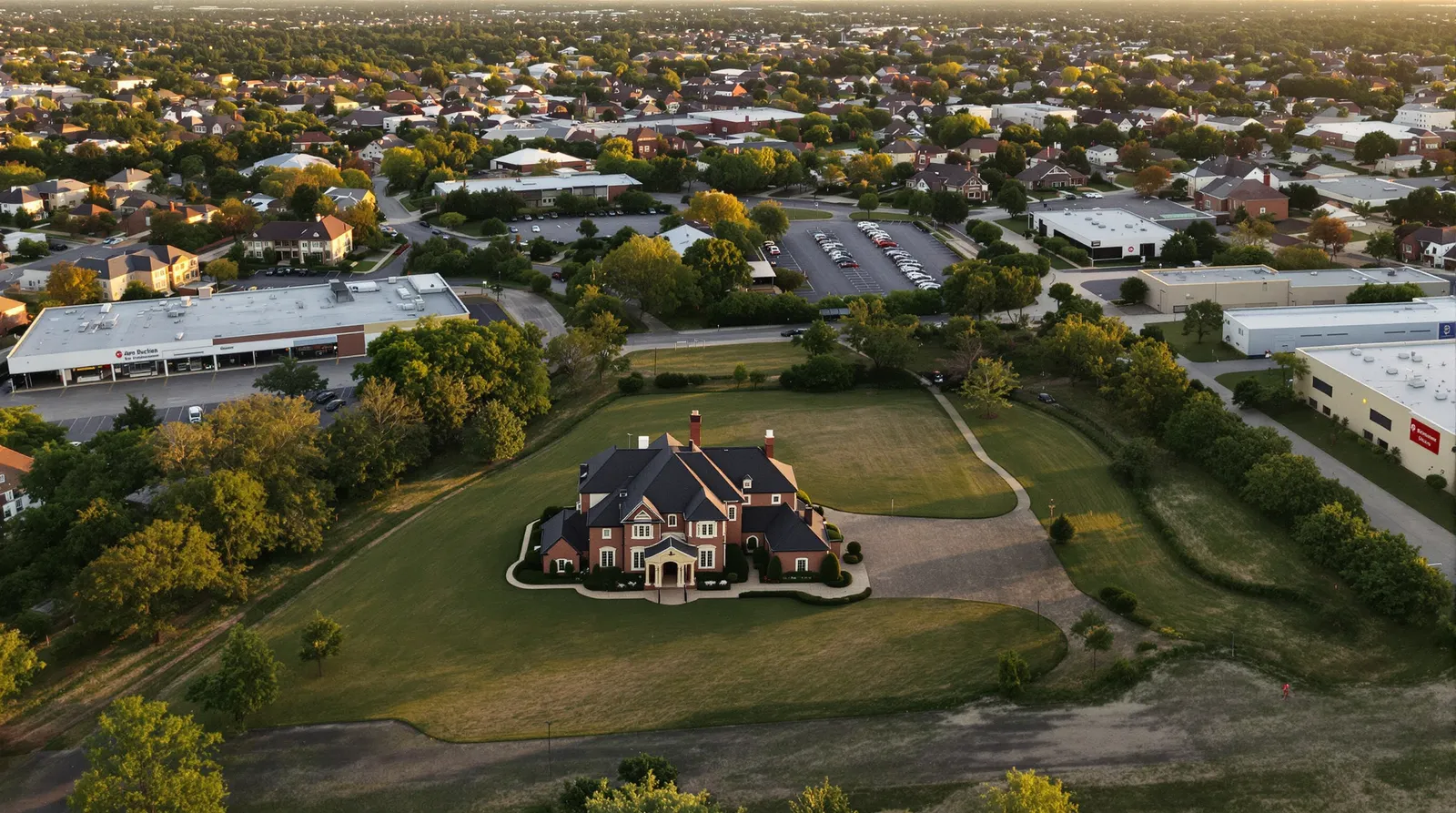
In August 2026, a mansion in Prosper sold for $4.5 million. That is a large number for most of us, and a shockingly small one for this particular house. Deion Sanders built the 29,000-square-foot estate in 1999, during his run with the Dallas Cowboys, and it first hit the market around 2009 asking $21 million. Fifteen years and a long line of price cuts later, it changed hands for a little over a fifth of that.
Here is what makes the story worth more than a celebrity headline. Prosper was one of the fastest-growing towns in America over those same years. Home values here climbed hard. So how does a trophy home lose roughly 80 percent of its asking price in a market that only went up?
The short answer is that three things pulled the price down at once, and none of them was the market falling. The first ask of $21 million was an aspirational number, not a market value, so every year after was a slow correction. Most of the land that held the real value had already been sold off, leaving an oversized house on about six acres. And the home is so custom, with a two-lane bowling alley, an indoor basketball court and a barbershop, that almost no buyer would pay for those features. That is a clean, useful lesson in how pricing actually works, and it applies to a $450,000 house in a new subdivision just as much as it does to Prime Time’s showplace.
The full pricing history: from $21 million to $4.5 million
The timeline is the whole story, and it is not one clean markdown. Here is the reported sequence of asking prices over roughly fifteen years (price history reported by CandysDirt):
- 2009 to 2011: listed around $21 million, the original peak ask on the full estate.
- After the 2014 land sale: relisted around $12.9 million, once most of the acreage was gone.
- 2016 to 2017: back up to about $14.5 million.
- 2019: down to roughly $7.5 million.
- A failed no-reserve auction that opened near $4 million, after which the property went through bankruptcy court in 2022.
- April 2025: returned to the market at $5.5 million, later trimmed to about $4.995 million.
- 2026: sold for $4.5 million.
That is a decade and a half of the price chasing the market downhill, with a few hopeful jumps back up along the way. Notice what it is not: a market crash. Prosper boomed the entire time. The house did not lose value because the town did. It lost value because the first number was never a market number, and every reduction after it was a slow, public correction toward what a buyer would really pay.
Why a home loses value in a market that only went up
A list price is not a fact. It is a question you ask the market, and the market answers with showings and offers. When a home is priced above what buyers will pay, the answer is silence, and the only fix is a price cut. Do that once and you corrected a small mistake. Do it a dozen times over fifteen years and you have told every buyer in the market that the seller does not know what the home is worth, which invites even lower offers.
That is the trap of anchoring to an aspirational number. The $21 million ask was a dream figure, not a comp-supported one. Once a home starts high and starts cutting, it loses the one thing that sells a house at a strong price: the burst of genuine interest in the first few weeks, when the most motivated buyers are paying attention. Miss that window and you are negotiating against your own stale listing.
The land was the real asset, not the house
Now the North Texas twist. When Deion built the place in 1999, it sat on about 109 acres of near-rural isolation. That land, not the house, was the valuable part, and most of it was sold off, reportedly down to around six acres after a 2014 sale to a developer. Subdivisions and the Shops at Prosper Trail, anchored by a Kroger that opened in 2016, filled in around what was left.
So two things happened at once. The acreage that carried most of the value was separated from the house, and the growth that made Prosper rich erased the specific thing that made this property special: its privacy and space. A secluded 109-acre celebrity retreat is a rare asset. A 29,000-square-foot house on six acres next to a shopping center is a very different, and much more ordinary, product. In a lot of North Texas deals, the land is the asset and the house is almost incidental. Knowing which one you are actually selling changes the price.
Super-adequacy: when a bowling alley subtracts value
The house is a marvel. Indoor pool, a two-lane bowling alley, an indoor basketball court, a home theater, a sauna, a barbershop, and a two-story closet reported at around 3,000 square feet. It is also a textbook case of what appraisers call super-adequacy, which is improvement beyond what the market will pay to get back.
The more a home is built around one person’s life, the smaller the pool of buyers who want it, and the less those features return at resale. Almost nobody shopping a Prosper estate is paying a premium for someone else’s bowling alley. They see rooms they will gut. Over-customization does not just fail to add value, it can subtract it, because it narrows your buyer pool to the handful of people who happen to want exactly what you built. Bigger and more custom usually means slower to sell and harder to price, not more valuable.
The Prosper market is already teaching this lesson in 2026
You do not have to go back to 1999 to see this play out. It is happening in Prosper right now. After years of a frenzy when almost anything sold, the market has shifted, and it is punishing the exact mistake that sank the mansion: pricing ahead of what buyers will actually pay.
- Prices have softened. The median Prosper home sold for around $850,000 town-wide in mid-2026, closer to $805,000 in the 75078 ZIP, little changed from a year earlier as the frenzy faded (Redfin, 2026). Buyers are no longer bidding prices up, so a list price set on last year’s momentum starts out above the market.
- Homes now sell below asking, and it takes patience. Prosper homes are selling for roughly 6 to 7 percent under their list price and taking about two months to sell (Redfin, 2026). Price above the market and you do not just wait longer, you usually settle for less.
- Price cuts are common and inventory is up. More than half of Prosper listings, about 54 percent, now take a price cut before they sell, up roughly 10 points from a year earlier (Redfin, 2026), and across Collin County values are down about 6 percent year over year (Zillow, 2026) with inventory well above its long-term average (housing analyst Nick Gerli, 2026). More homes competing for choosier buyers is exactly the setup that turns an ambitious list price into a string of cuts.
Here is the part sellers miss in a cooler market: it is not that homes are not selling. Well-priced ones still move fast. Redfin notes that the sharpest, best-priced Prosper listings still go pending in about three weeks near full price, while the typical home now sells 6 to 7 percent under ask (Redfin, 2026). The whole gap is between the sellers who price to today’s market and the ones who anchor to last year’s, or to a dream. One group closes near asking and quickly. The other watches the days pile up and cuts.
The median Prosper home sold for around $850,000 in 2026 (Redfin, 2026), a world away from a $4.5 million estate. The dollar signs are different. The lesson is identical, and right now the local data is making the case louder than any single sale could.
Thinking about selling in Prosper? The honest first step is knowing your number in today’s market, not last year’s. I will pull the real comparable sales for your home and your street and tell you plainly what it would sell for, free and with no pressure. Get a free home value estimate.
What every Prosper seller can take from it
You do not own a 29,000-square-foot mansion, and you do not need to in order to use this. The same forces set the price of a normal home:
- Price to the market from day one. Your strongest buyers show up in the first two to three weeks. A right price captures them. A high price wastes them and forces the reductions that cost you more than pricing right would have.
- Your list price is a test, not a wish. It is not what you paid, what you owe, or what you want to net. It is what recent comparable sales on your street support today.
- Know whether you are selling a house or land. In North Texas that distinction is real money, especially on acreage at the growing edge of a town like Prosper, Celina or Van Alstyne.
- Be careful over-building for resale. Improve for the broad market, not for a single-purpose showpiece only you will love.
None of this is about the market being weak. Prosper is strong. It is about respecting what the market will actually pay and pricing to it, instead of anchoring to a number and spending years learning the hard way. The most expensive mistakes in real estate are almost always pricing mistakes, and they are the most avoidable ones too.
If you are thinking about selling in Prosper or anywhere in Collin County, I would rather help you price it right the first time than watch you chase the market down. I pull the real comparable sales for your home and your street, tell you the honest number, and price it to sell without leaving money on the table. See how the Prosper market is really moving, or read how I approach selling a home in North Texas. I am a REALTOR®, and pricing your home well is the part of this job that earns its keep.