People ask me all the time how much land makes a ranch, hoping for a clean number, and the honest answer is that there is not one. No Texas law and no federal rule says a ranch starts at 10 acres, or 50, or 500. The word is a feeling and a use, not a size. But that does not mean the question has no answer, because underneath the label there are three real numbers that decide what a piece of North Texas land can actually be. Get those right and the name takes care of itself.
Those three numbers are the acreage your county requires for an agricultural tax valuation, the stocking rate it takes to genuinely run cattle on the grass you have, and what the land costs per acre. I come at this from a slightly unusual angle for a REALTOR®: I grew up in a ranching family and I run cattle on my own land up here, so I have felt the difference between what looks like enough land and what actually feeds a herd. Below I walk through all three numbers, plus what is quietly happening to the size of North Texas ranches. I am a REALTOR®, not an appraiser or a tax advisor, so treat this as a plain-English map, then confirm the specifics with the county appraisal district before you act.
How much land is a ranch? Start by admitting there is no rule
Let me clear the biggest myth first. There is no official acreage that turns land into a ranch, in Texas or anywhere else. Property-tax law does not use the word, the USDA does not use it, and no agency sets a threshold. Ranch is a common-usage term for a place that runs grazing livestock, usually cattle, and people apply it to everything from a few acres with a couple of cows to a hundred-thousand-acre operation. So if a listing or a neighbor tells you a real ranch starts at some magic number, that is an opinion dressed up as a fact.
That is freeing, actually. It means you stop chasing a label and start asking the questions that matter: What do I want this land to do? What will the county let it be for tax purposes? And what will the grass actually support? The rest of this guide is those three questions in order.
Not sure how much land you need for what you have in mind? Tell me the goal, whether it is running cattle, holding horses, or just room to breathe, and I will help you size it to real numbers.
The number the law cares about: your county’s ag-valuation minimum
If any number deserves to be called the threshold, it is this one. The single biggest financial fact about rural land in North Texas is whether it carries an open-space agricultural valuation, the tax treatment people call an ag exemption. Land in qualifying ag use is taxed on its productivity value instead of full market value, which can cut the annual tax bill by a large multiple. That valuation, not any romantic idea of a ranch, is usually what makes owning acreage pencil out.
Put rough numbers on it and the point lands. A 30-acre tract near a growing town might carry a market value around $12,000 an acre, or $360,000, which at a combined tax rate near 2 percent would run about $7,000 a year taxed at market. Under an open-space ag valuation, that same land is taxed on its far lower agricultural productivity value, which can drop the yearly bill to a few hundred dollars. The appraisal district sets the real productivity value and rate, so treat that as an illustrative gap rather than a quote, but a swing of several thousand dollars a year is exactly why the valuation, not the acreage or the label, is the number that decides whether a place pencils out.
Each county appraisal district sets its own minimum acreage and intensity standards, so the number moves as you cross county lines:
- Grayson County generally requires at least 10 acres in genuine agricultural use, set by the appraisal district’s agricultural advisory board.
- Collin County publishes no hard acreage minimum but expects a livestock operation to run a minimum number of animal units year-round, which effectively sets a floor through the stocking standard rather than a raw acre count.
- Denton County uses a prudent-manager standard and generally wants to see the land in ag use for five of the past seven years, rather than a fixed acreage.
In every county the land also has to meet a degree-of-intensity standard, meaning real, typical agricultural use, not a token animal on a mowed lot. Acreage alone never qualifies you. This is exactly the trap that catches buyers of small tracts who assume any rural parcel gets the break. I dig into how the valuation is earned, transferred and lost, including the rollback tax that can claw back the savings, in my Grayson and Fannin ag-exemption guide. And if livestock is not your path, managing the land for native wildlife can hold the same valuation without running cattle at all.
The number the grass cares about: how much land it takes to run cattle
Here is where my day job and my cattle collide, and where I watch new landowners get surprised most often. Running cattle takes far more land than people expect, because the limit is not the fence line, it is the forage. The measure ranchers use is the stocking rate: how many animal units the land can carry without being overgrazed. An animal unit is a 1,000-pound cow with a calf, eating roughly 26 pounds of forage a day.
How many acres it takes to support one animal unit depends entirely on the kind of grass:
| Pasture type (Blackland Prairie / Post Oak) | Acres per animal unit | Land for 5 cow-calf pairs |
|---|---|---|
| Native rangeland | ~8 to 15 acres | ~40 to 75 acres |
| Improved, fertilized pasture | ~3 to 6 acres | ~15 to 30 acres |
| Wooded / brushy ground | ~50 to 75 acres | ~250+ acres |
Stocking rates from Texas Parks and Wildlife and NRCS livestock-management figures for the Post Oak Savannah and Blackland Prairie, as summarized by Texas A&M AgriLife Extension. An animal unit is a 1,000-pound cow with calf. Rates are general starting points; actual carrying capacity depends on range site, condition and rainfall, and a grazing plan should set the real number.
Read that table twice, because it reframes the whole “how big is a ranch” question. Five cows, a genuinely small herd, want somewhere between 15 and 75 acres depending on whether you have improved pasture or native range. In the Cross Timbers, native range often runs on the heavier end, needing more acres per cow, not fewer. That is why 10 acres can be a fine place to keep a couple of head on good grass but is not, on its own, a cattle operation.
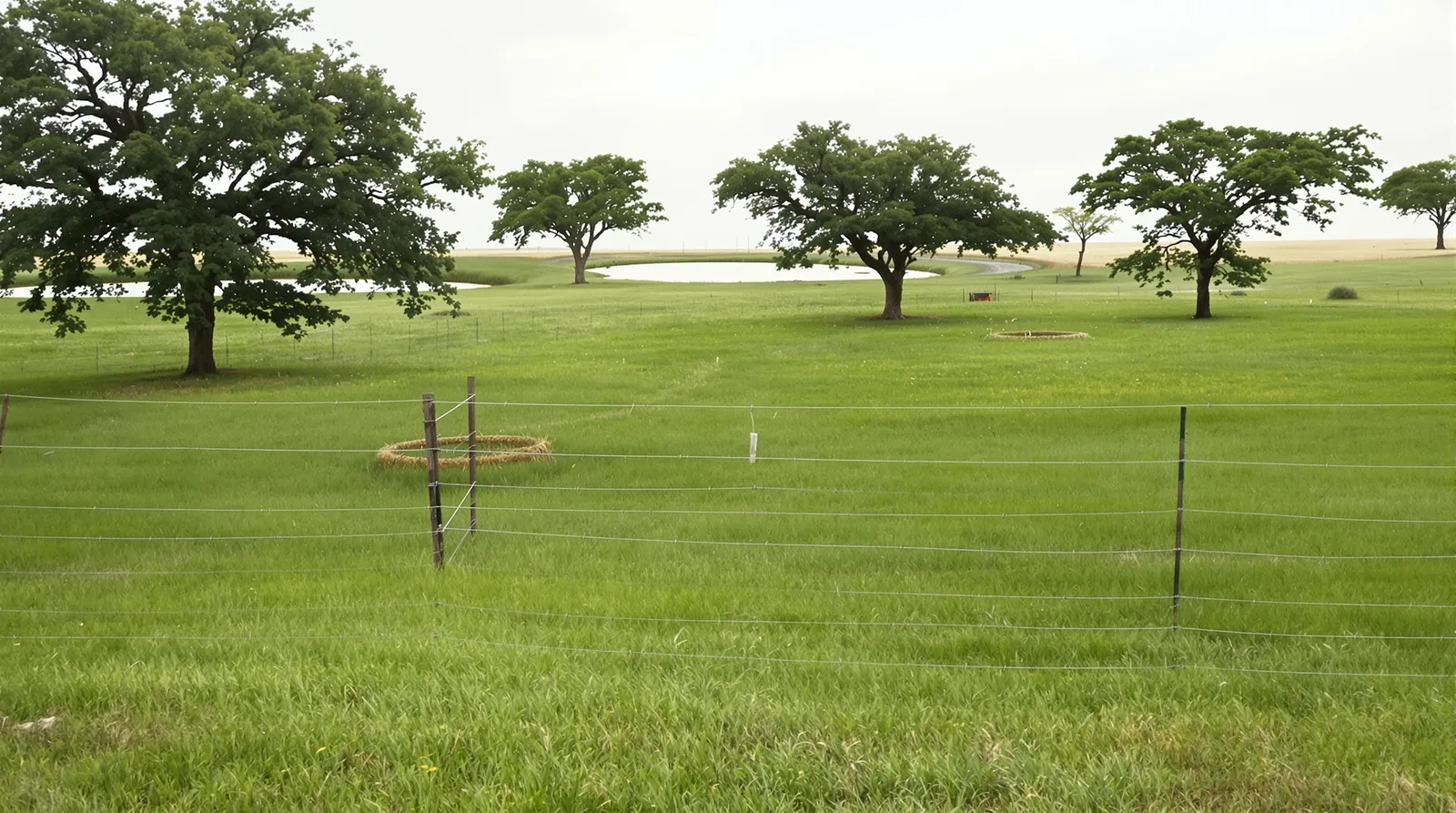
The most expensive mistake I see is overstocking: putting more cattle on a place than the grass can feed, then buying hay all year to cover the gap and beating the pasture down so it recovers poorly. On my own grass I plan for the light end of the range, not the wet-year peak, because a dry North Texas summer punishes anyone who stocked for rain that never came, and a pasture grazed too hard takes seasons to come back. Undersize the herd to the land, not the other way around. If you are weighing a tract and want a straight answer on how many head it will carry, that is exactly the kind of read I do before you buy, and where I lean on what I have learned running my own.
Thinking about a specific piece and whether it will run the cattle you want? Send me the tract and I will give you a straight read on the grass, the water and the carrying capacity.
The number your budget cares about: what an acre costs
The third number ties the first two to reality, because acreage you cannot afford is not a plan. And North Texas land prices break the intuition most buyers arrive with: the smaller the tract, the more you pay per acre, not less.
Small tracts of 10 to 50 acres, which is what most buyers actually shop, ran a median around $24,000 an acre in closed NTREIS sales of that size through mid-2026, and $30,000 to $37,000 an acre in the fast-growing counties, roughly $30,000 in Grayson, $34,000 in Denton and $37,000 in Collin. True large working ranches sell for far less per acre, on the order of $9,000 an acre for big rural tracts, and regional figures from the Texas Real Estate Research Center put Northeast Texas rural land in the $8,000 to $10,000 range as a blended average across all sizes. A small homesite-sized tract near a growing town can cost three to four times as much per acre as a big ranch an hour out.
That gap is the reason the “how much land is a ranch” question has a budget answer too. Fifteen acres of improved pasture that will run a few head might cost more per acre than a 300-acre working ranch, because it is competing with buyers who want a place to build, not just to graze. I break down exactly what drives the per-acre number, size, water, access, ag status and location, in my guide to how much ranch land costs per acre.
What is quietly happening to the size of North Texas ranches
Here is the part almost no one tells buyers, and it is the real story behind all three numbers. North Texas ranches are getting smaller and more fragmented, fast.
According to Texas A&M’s Texas Land Trends research, Texas lost about 3.7 million acres of working farms, ranches and forests between 1997 and 2022, and more than 1.8 million of those acres in just the last five-year span. Over 17,000 agricultural operations disappeared in that recent window. The result is a landscape tilting toward many small pieces: ownerships under 100 acres now make up roughly 60 percent of all agricultural properties in Texas, yet hold only about 3 percent of the farmland. The big blocks are being carved up, mostly on the fast-growing metro fringe, which is precisely the country north of Dallas where my clients are buying.
That is why the average Grayson County farm today runs around 140 acres, a fraction of the 544-acre statewide average, and why so many listings up here are 10, 20, 40-acre pieces cut from what used to be a single ranch. It also explains the price twist above, and it raises a specific caution for buyers: when a tract is split off a larger ranch, its ag valuation, its access, and its water can all change with the survey line. A piece that grazed fine as part of a bigger place may not carry the valuation, or the cattle, on its own.
I will be straight about why this matters to me personally. I come from a ranching family, and watching working land around here get subdivided into ranchettes is bittersweet. It is also the market as it actually is, and my job is to help you buy into it with your eyes open: to know whether the pretty 20 acres will really run the cattle you picture, hold its tax valuation, and be worth what you pay. I am a REALTOR®, not an appraiser or a tax advisor, so I read the land and the fences and the paperwork with you, and bring in the surveyor, the appraiser and the appraisal district to certify what has to be certified.
So how much land IS a ranch? A practical answer
If you want a working answer instead of a non-answer, here is mine, built from the three numbers rather than a label:
- A few acres to about 20: a homesite with room, a hobby place, or a couple of head on good improved pasture. It can qualify for the ag valuation in a county like Grayson if it hits the acreage minimum and the intensity standard, but it is not a cattle operation.
- Roughly 20 to 100 acres: the heart of what most North Texas buyers actually call a small ranch. Enough improved pasture to run a real, if modest, herd, qualify comfortably for the valuation, and still be reachable in price on a per-acre basis.
- A few hundred acres and up: a genuine working ranch, priced against a smaller pool of buyers, which is why the per-acre number drops even as the total climbs.
None of those are legal definitions. They are how the land behaves once you run it through the tax minimum, the stocking rate and the price. Tell me what you want the place to do and I will tell you straight which bracket you are really in.
How I help, and where to start
The through-line in all of it is simple. “Ranch” is a word, but what your land can do is decided by real numbers: what the county requires, what the grass will carry, and what the acre costs. Miss any one of them and you can overpay for land that will not run the cattle you pictured or hold the tax valuation you counted on.
Before you buy, I read the tract against all three: I verify the current ag status with the appraisal district, give you a straight read on the grass and water and carrying capacity, and pull real comparable sales so you know the per-acre number is fair. If you already own land and want to know where you stand, start with what your land is worth. When you are weighing the land itself, my North Texas ranch and land guide covers buying and selling acreage, with dedicated guides on farm and cropland, hunting and recreational land, and land across Grayson and Fannin counties. My property-tax guide covers keeping the tax bill in check after you close.
When you want a real answer for a real piece of ground, tell me the tract or the area, call or text me at (903) 568-6626, or book a 30-minute consult. You will size the land to what you actually want, on facts instead of a label.
I am a REALTOR®, not a licensed appraiser, surveyor, tax attorney or CPA. Nothing here is an appraisal, a stocking recommendation, or tax advice. Acreage minimums, degree-of-intensity standards, stocking rates and land values vary widely by county, tract, ecoregion, range condition and time, and change constantly. Farm-size and land-loss figures cited here come from the USDA 2022 Census of Agriculture and Texas A&M’s Texas Land Trends; stocking rates from Texas Parks and Wildlife, NRCS and Texas A&M AgriLife; per-acre figures from closed NTREIS sales and the Texas Real Estate Research Center. Confirm current requirements with your county appraisal district and a qualified professional, and confirm carrying capacity with a grazing plan, before you rely on any number here. Market notes are general and current as of August 2026.